Background
Head protection is a critical element in reducing the risk of traumatic brain injury (TBI) across industries and sports. Traditional helmet certification tests focus mainly on preventing skull fractures by limiting peak linear accelerations. However, recent research, including our work underpinning the HIPER (Helmet Impact Protection Effectiveness Rating) program, has shown that rotational head motion is central to understanding brain injury mechanisms.
At HIAP, we apply our expertise in biomechanics and advanced injury criteria to help helmet manufacturers go beyond minimum regulatory requirements and develop safer, more competitive products.
Our Approach
We designed and carried out a series of helmet impact tests that combined:
1. Standard certification protocols (for compliance and benchmarking).
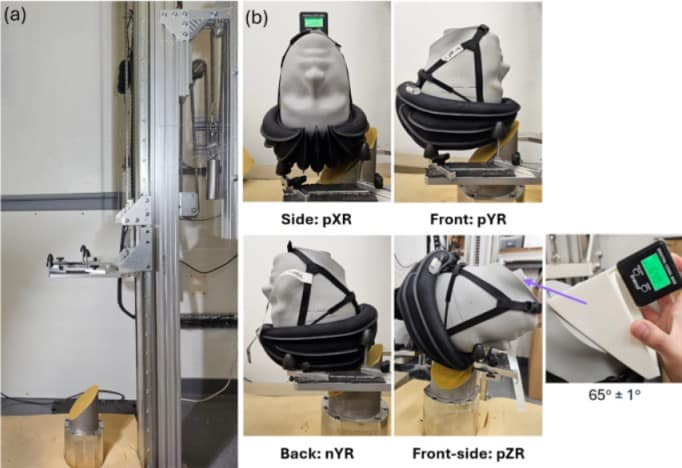
2. Research-informed test methods, developed from the latest biomechanical insights, including our contributions to the HIPER program.
Performance was evaluated using a comprehensive set of injury criteria:
1. Conventional measures such as peak linear head accelerations.
2. Advanced rotational injury metrics such as peak angular acceleration and the Brain Injury Criterion (BrIC).
To ensure clarity and impact, we delivered results through detailed reports supported by visual analysis, enabling clients to directly compare how different helmet designs performed across multiple test conditions.
Outcomes
Our testing programmes provided manufacturers with critical, research-driven insights into helmet performance. This allowed them to:
1. Identify strengths and weaknesses in their designs.
2. Optimise helmet structure and materials to improve protection against both linear and rotational forces.
3. Demonstrate the performance of their novel solutions compared with conventional designs.
The inclusion of HIPER-inspired metrics ensured that results aligned with the latest independent helmet rating frameworks, giving our clients an edge in both product development and market positioning.
Clients
We have delivered helmet testing consultancy and analysis for a diverse range of clients, ranging from manufacturers of industrial safety helmets to producers of motorcycle, bicycle, and innovative helmets. These collaborations have supported the development of cutting-edge products that meet both industry standards and the latest research-based safety benchmarks.
Collaborations
In partnership with our clients, we have also co-applied for government-funded research programmes, including several Innovate UK Smart Grants. These joint initiatives strengthen the link between research and industry, enabling the development of helmet technologies that are not only scientifically validated but also commercially viable.
Publication
Baker, C. E., Yu, X., Lovell, B., Tan, R., Patel, S., & Ghajari, M. (2024). How well do popular bicycle helmets protect from different types of head injury?. Annals of Biomedical Engineering, 52(12), 3326-3364.
Tan, R., Baker, C. E., Yu, X., & Ghajari, M. (2025). Superior linear and comparable rotational protection of an air-filled helmet versus foam helmets. Scientific Reports, 15(1), 27364.