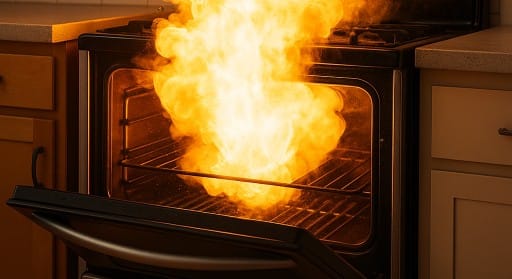
HIAP was appointed as an independent third-party consultant in a medico-legal case involving suspected traumatic brain injury (TBI) following a domestic gas oven explosion. The incident occurred when a delayed ignition caused a fireball to erupt from the oven just as the individual was leaning in to inspect it. There was no direct object impact, but the person was exposed to intense blast wave pressure and heat at very close range.
Although brain imaging showed no structural abnormalities, the individual developed ongoing symptoms—including tinnitus, dizziness, sleep disturbance, memory problems, and emotional volatility—all commonly associated with TBI. The key question was whether the exposure to the blast wave and fireball could have caused a brain injury, despite the lack of visible trauma.
HIAP was instructed to provide an independent, biomechanical assessment of the event. We were not engaged to support either party’s position, but to examine whether the physical forces involved in the incident were consistent with known mechanisms of brain injury. Our consultants have deep expertise in blast-induced traumatic brain injury, with peer-reviewed research in this area. It was this background that led the final legal team—after years of stalled progress and multiple handovers—to seek HIAP’s input to evaluate the complex mechanism of injury.
We carried out a two-part investigation:
1. Engineering Simulation:
Using scene photographs, oven dimensions, and estimated gas accumulation, we reconstructed the explosion and simulated the event using fluid-structure interaction methods. The estimated blast wave overpressure at head height ranged from 140 to over 300 kPa, depending on the combustion efficiency and reflection surfaces. These levels are significantly higher than those typically encountered in domestic environments and known to cause injury.
2. Scientific Review:
We reviewed peer-reviewed studies of blast exposure in both animal models and human subjects. Research has shown that overpressures as low as 17–80 kPa can cause structural and functional changes in the brain, even when standard scans show no damage. Documented symptoms in these studies closely matched those reported in the case.
Our findings showed that the physical forces generated by the explosion were within a range known to cause brain injury through primary blast mechanisms. We did not comment on the diagnosis or outcome but provided technical evidence to help the court understand the potential relationship between the exposure and reported symptoms.
After more than six years and involvement from multiple legal teams, the case was eventually resolved through settlement. Our independent analysis played a key role in bridging the gap between clinical symptoms and the physical forces involved.
This case underscores the importance of recognising non-traditional injury mechanisms in legal contexts, and the value of independent biomechanical expertise in supporting scientifically credible evaluations when conventional diagnostics fall short.