A legal firm contacted our team to assist them in an injury case. It involved a fall from ladder in a construction site, where the individual did not wear a helmet as required. Their question was: could wearing a hard hat prevent the head injuries or reduce their severity?
Intuitively and from our years of research in this field, we knew that wearing helmets are better than not wearing them. However, the efficacy of the helmet for a fall from a 3m height was disputed. And the fact is that hard hats currently are designed for preventing head injuries due to falling objects and not falls. In addition, the head impact conditions, i.e. impact speed, angle and location, after falling onto the ground from a 3m height are unknown.
This project was quite timely because in last three years, we have been studying the performance of hard hats under trips and falls. This was made possible through an Innovate UK grant followed by an industry funding to the HEAD Lab, Imperial College. We have published a journal paper and a conference short communication and have another journal paper in revision. In addition, we held a workshop for a range of stakeholders, including delegates from standard committees, insurance companies, solicitors, hard hat manufacturers and construction companies, where we disseminated the results of our research.
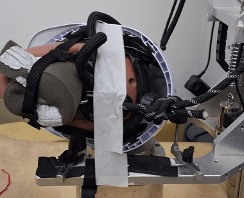
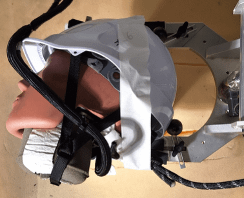
To answer the lawyers’ question, we combined computational and experimental techniques. We modelled the fall in MADYMO multi-body dynamics software using the available information about the incident and performed over 100 simulations to determine the range of head impact conditions. Based on available injury details and biomechanical thresholds, we selected the most likely impact speed. Several samples of the hard hat provided by the construction company for their workers was purchased. These hard hats were tested under the fall conditions using HEAD Lab’s advanced helmet test rig. Each test was repeated three times to ensure variations across helmets and tests are included in the analysis. The test conditions were also varied slightly to incorporate the effects of undertrain parameters on the results.
Using the skull fracture criterion and its risk function, we found that wearing the hard hat could reduce the risk of skull fracture by approximately 10% to 30%.
Our report helped settle the claim. Our biomechanical analysis helped establish a scientific perspective on the extent to which not wearing a helmet may have influenced the individual’s injury and the resulting liability. This work, once again, shows the importance of wearing helmets wherever there is a risk of head impacts, from industrial to domestic settings.