
A legal case, involving a cyclists and a driver, was referred to our team last year.
According to the police report, the cyclist was passing a roundabout when a car pulled into their path. This resulted in a collision with the car and the cyclist was projected over the front of the car and landed on the road surface.
The cyclist’s symptoms were initially reported as headaches, but later they started reporting cognitive problems, which had significant consequences for their job.
However, the driver’s insurance provider questioned the level of force involved in the collision.
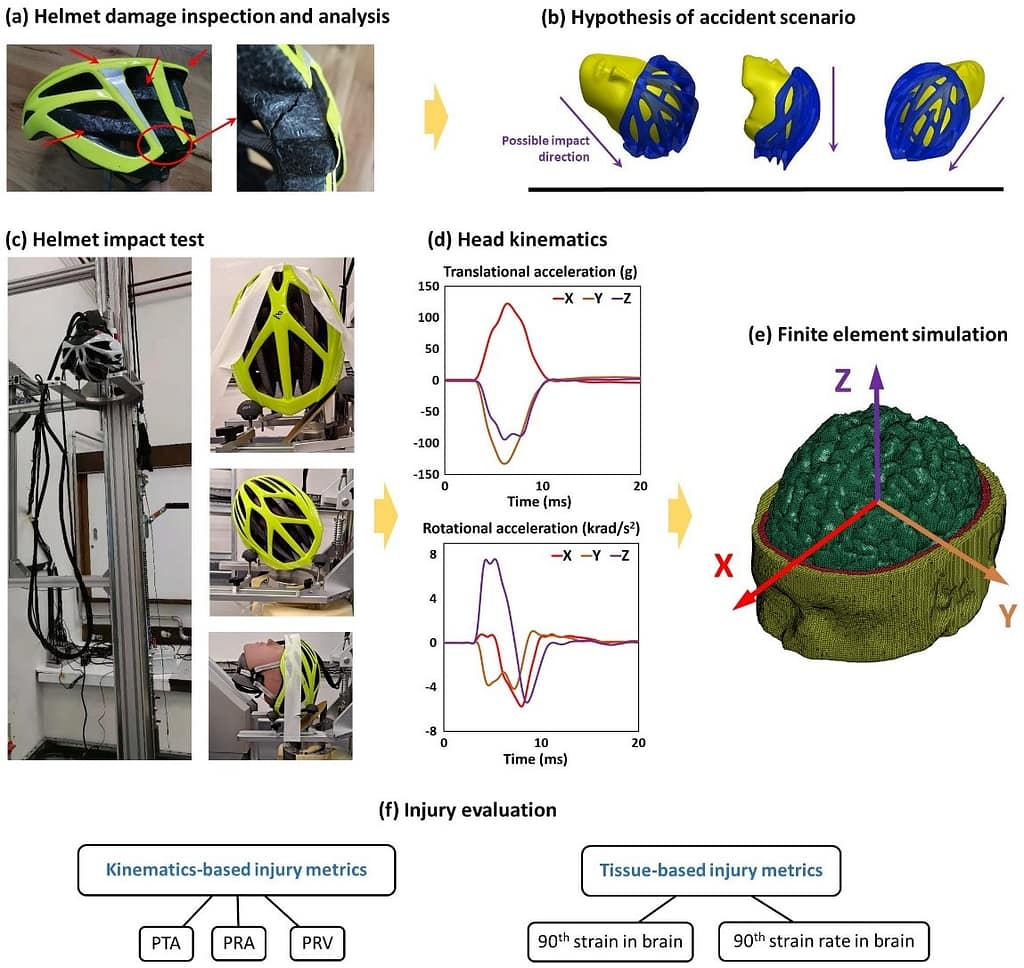
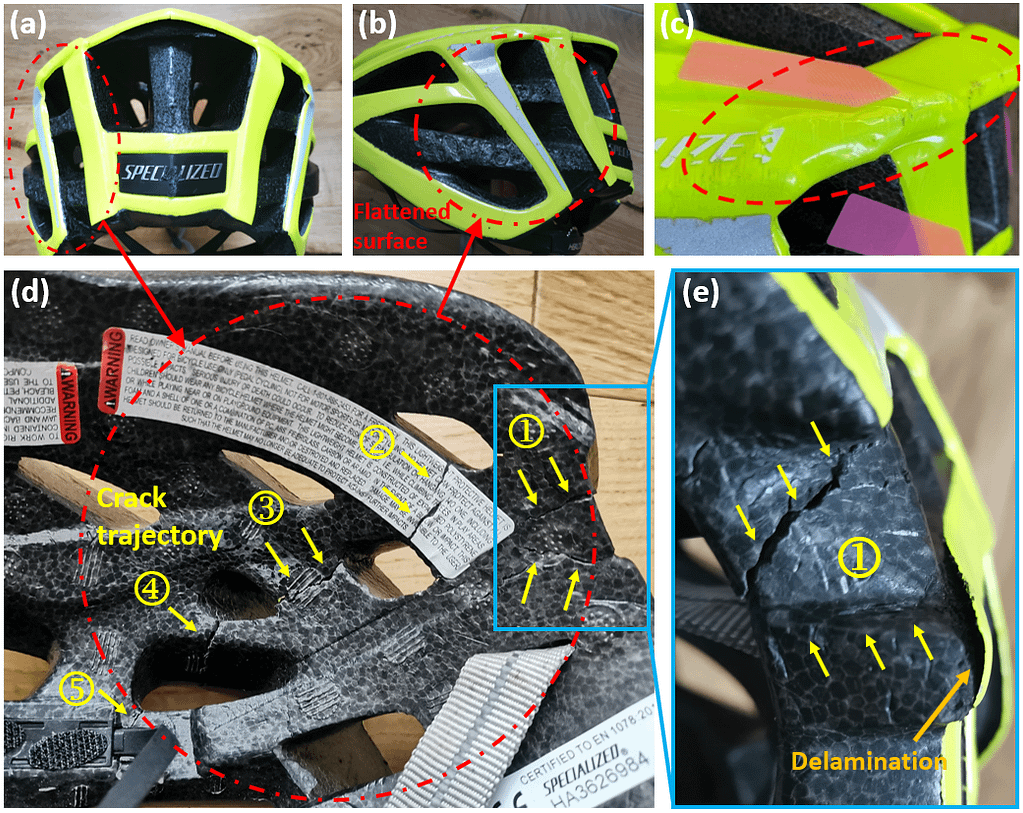
The only piece of evidence that was provided to us was the crash helmet. Through a thorough inspection, we formed a hypothesis regarding the incident. We tested our hypothesis by simulating impacts on our helmet test rig using surrogate helmets.
After 9 iterations, we accurately reconstructed the damage on the crash helmet in an impact on an oblique anvil with a speed of 7.3 m/s. We predicted large head kinematics and mechanical strain and strain rate within the brain.
These results helped the cyclist to receive a pre-court settlement by the insurance company with a significantly higher amount of compensation than originally claimed.
Our collision reconstruction method
We published this case in a peer-reviewed journal. You can read the full paper here